
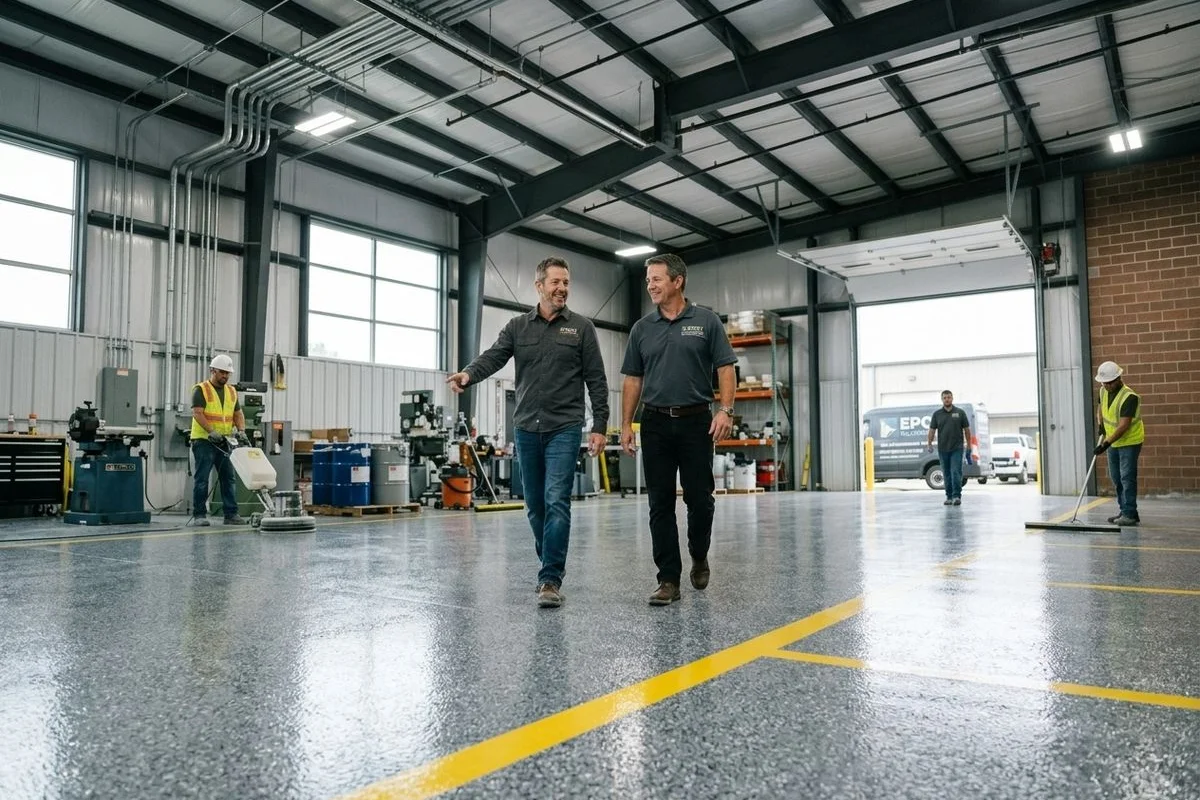
Industrial Epoxy & Urethane Floor Coatings in Detroit, MI
High-performance epoxy and urethane cement floor systems for Detroit's automotive manufacturing plants, warehousing facilities, and heavy industrial operations.
The Industrial Standard in High-Performance Floor Coatings for Detroit Facilities
Detroit’s industrial floors take punishment that most contractors never encounter on residential or light commercial jobs — multi-ton stamping presses shaking the slab, CNC machining coolant pooling in low spots, forklift traffic running 22 hours a day hauling engine blocks and transmission housings, and Michigan’s brutal freeze-thaw cycling cracking every poorly specified coating system from November through April. Thin-film paints and water-based “epoxy” products simply do not survive these conditions. What Detroit’s manufacturing plants, distribution centers, and processing facilities need is an engineered floor system: one specified for the actual chemical exposure, actual traffic loads, and actual climate conditions that southeast Michigan delivers.
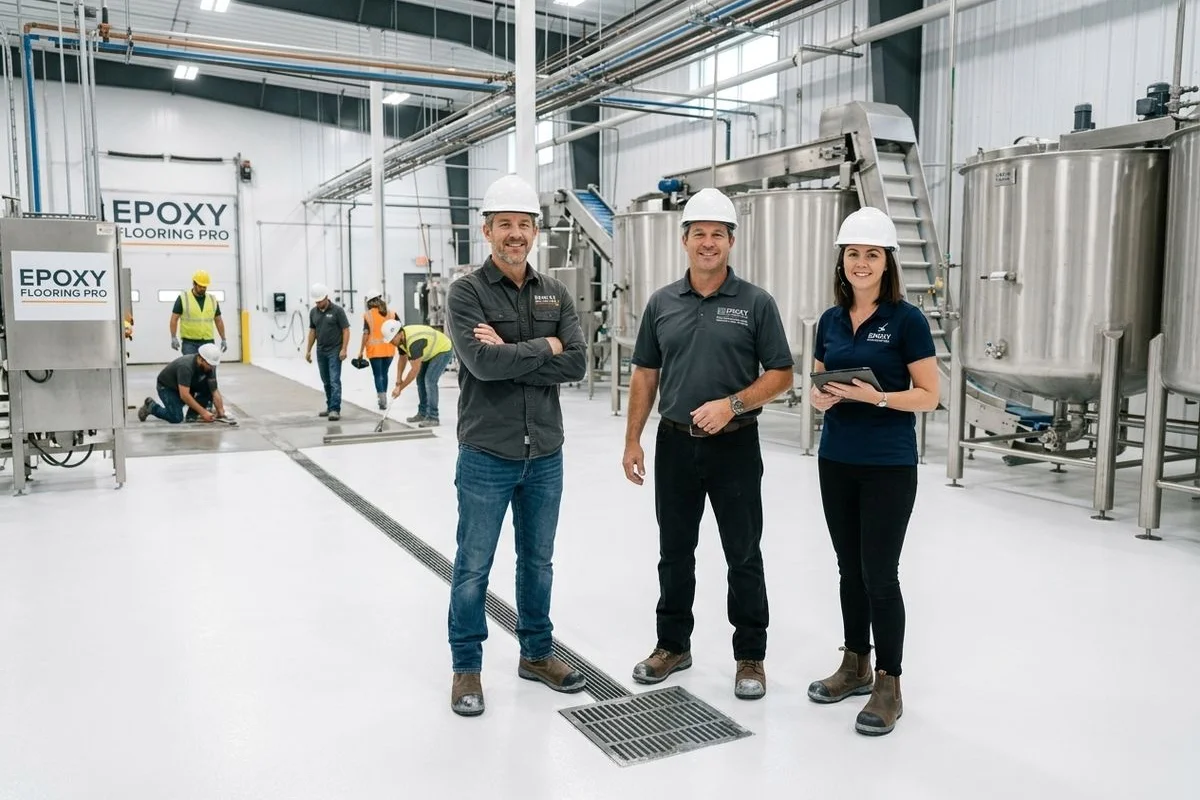
Epoxy Flooring Pro installs 100% solids epoxy and urethane cement floor systems exclusively for commercial and industrial clients across the Detroit metro area. We do not install residential garage floors. Our entire operation — equipment, crews, material suppliers, engineering knowledge — is built around the demands of automotive manufacturing plants in Dearborn and Warren, distribution centers along the I-94 and I-75 corridors, food processing facilities near Eastern Market, and heavy warehousing operations from Romulus to Sterling Heights.
Why 100% Solids Epoxy Outperforms Water-Based Alternatives
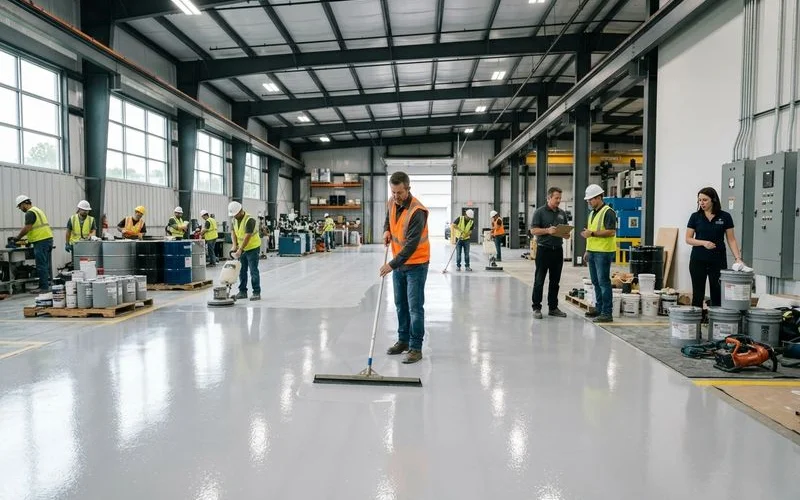
Not all epoxy coatings are equal, and Detroit’s industrial contractors have learned this the hard way. The critical distinction in industrial flooring is percent solids — the proportion of the material that remains as a cured film after all solvents and carriers evaporate. Water-based and solvent-based epoxies may test at 40–60% solids, meaning nearly half the product disappears during cure, leaving a thin, compromised film that Michigan’s climate and heavy industry will destroy in months. 100% solids epoxy systems cure entirely in place with no evaporative loss, resulting in:
- Full-thickness film builds with every coat — typically 10–20 mils DFT per application
- Higher cross-link density for superior chemical and abrasion resistance
- Zero VOC off-gassing during cure — critical for occupied facilities with ventilation restrictions
- Better substrate penetration for mechanical and chemical adhesion
For heavy industrial applications across Detroit, we specify only 100% solids formulations as base coats. Decorative or UV-stable topcoats may use aliphatic urethane or polyaspartic chemistry, but the structural layers of every system we install are 100% solids epoxy. This is especially critical in automotive manufacturing environments where machining coolants, stamping lubricants, and hydraulic fluids are part of daily operations.
Urethane Cement for Detroit’s Extreme Environments
Detroit’s industrial facilities often deal with conditions that push even high-quality epoxy beyond its performance envelope. Where temperatures swing dramatically — loading docks exposed to sub-zero Michigan winters, wash bays running 180°F pressure wash cycles, or cold storage facilities cycling between freezing and ambient temperatures — urethane cement systems outperform standard epoxy. Urethane cement bonds chemically to the concrete substrate at a fundamentally different level, creating a composite layer that can flex with the slab. Key advantages:
- Thermal shock resistance rated to 250°F continuous service
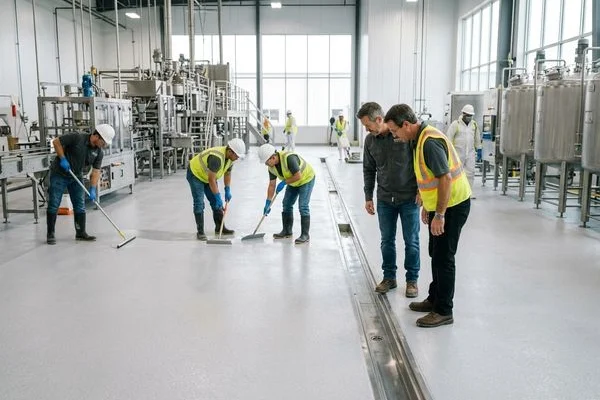
- Thermal cycling tolerance — ideal for cold storage, brew houses, and food processing drain areas
- High moisture vapor tolerance — can be installed on slabs with up to 25 lbs/1,000 SF/24hr emission rates
- Excellent chemical resistance to organic acids, fats, and cleaning agents
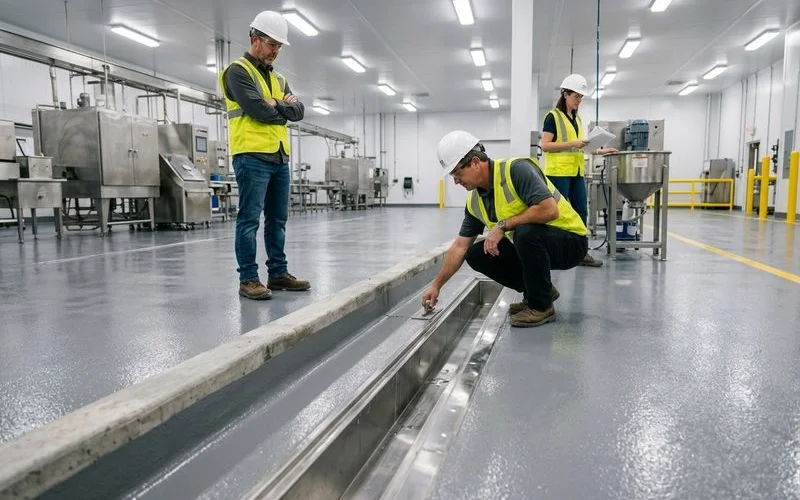
We regularly specify urethane cement for the wet processing zones of Detroit-area food and beverage facilities — from meat processors near Eastern Market to beverage production operations — combined with 100% solids epoxy in the dry production and warehousing areas of the same project. For automotive plants running coolant wash-down bays, urethane cement handles the thermal cycling that cracks standard epoxy within one Michigan winter.
System Selection: Matching the Specification to Your Detroit Facility
There is no single “best” epoxy system. The correct specification depends on a careful analysis of your facility’s conditions — and in the Detroit metro area, those conditions span everything from climate-controlled assembly lines to unheated warehouses where the slab temperature hits 15°F in January. Before we quote any project, our engineers evaluate:
Substrate Conditions
- Concrete compressive strength and surface profile
- Moisture vapor emission rate (MVER) — the leading cause of coating delamination and especially problematic in older Detroit industrial buildings with no vapor barriers
- Existing contamination: oil, hydraulic fluid, machining coolant impregnation, or old coatings
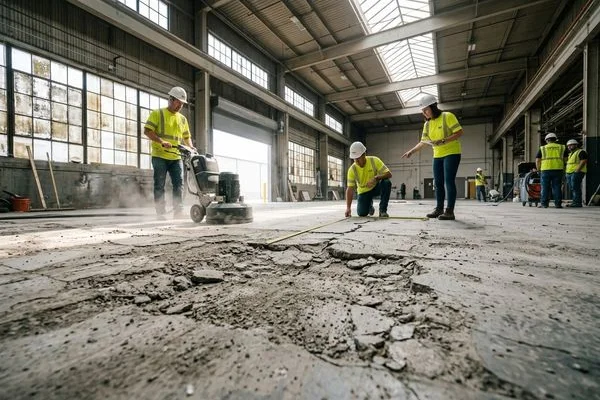
- Crack patterns and joint configuration — freeze-thaw damage is pervasive in southeast Michigan slabs
Operational Demands
- Forklift type, weight, and tire composition — Detroit warehouses and plants run everything from propane sit-downs to 15,000 lb capacity electric trucks
- Chemical exposure: type, concentration, frequency, and contact duration
- Temperature range: ambient, process, and cleaning temperatures
- Sanitation protocol: dry sweep, wet mop, high-pressure wash, or steam cleaning
Regulatory Requirements
- USDA/FDA compliance for food contact environments
- ESD dissipative requirements for electronics manufacturing
- Anti-slip coefficients of friction for OSHA compliance
- Containment requirements for chemical storage areas
Based on this assessment, we prepare a written specification with product data sheets, coverage rates, and application parameters — not a price per square foot on a napkin. Detroit-area facilities deserve specifications engineered for the specific conditions they face, not generic recommendations copied from a catalog.
Installation: Where Most Detroit-Area Contractors Fail
The most expensive coating system in the world will delaminate if the substrate preparation is inadequate. Surface preparation is the foundation of every successful floor coating, yet it is the phase most frequently shortcut by contractors competing on price across the metro Detroit market. We see it constantly: facilities in Dearborn, Warren, and along the Mt. Elliott industrial district with coatings peeling within months because someone skipped shot blasting to save two days on the schedule.
Our preparation standard:
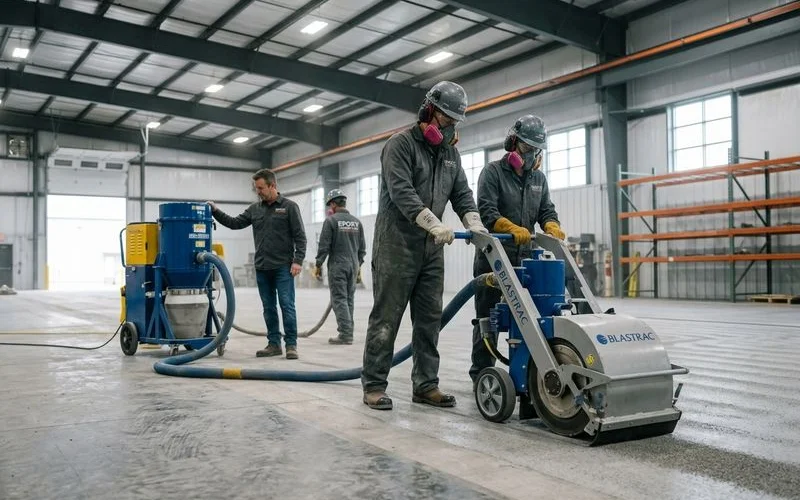
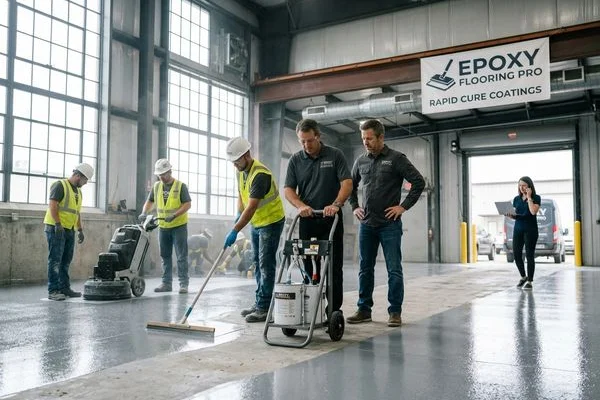
Shot Blasting is our primary preparation method for large open floor areas. Containerized shot blasters recapture the blast media, leaving a clean, profiled surface to ICRI Concrete Surface Profile 4–6 with minimal dust. We do not subcontract shot blasting — our operators own and maintain our equipment.
Diamond Grinding is used at walls, columns, doorways, and tight areas shot blasters cannot reach, as well as for surface leveling before overlay systems. We carry multiple grinder sizes from walk-behind planetary grinders to hand-held edge grinders.
Scarifying is deployed for removing existing coatings, traction materials, or heavily contaminated concrete layers where abrasive blasting alone is insufficient. In older Detroit manufacturing buildings — many dating back to the mid-20th century — we frequently encounter multiple layers of failed coatings over decades of oil saturation that require aggressive scarification.
After mechanical preparation, all dust is HEPA-vacuumed and the surface is inspected for residual contamination before any material is applied.
Color, Texture, and Functional Design Options
Industrial flooring does not have to be gray. Beyond performance, epoxy systems offer significant flexibility in appearance and functional design — and Detroit’s Tier 1 and Tier 2 automotive suppliers increasingly demand organized, color-coded production floors as part of their lean manufacturing and 5S programs:
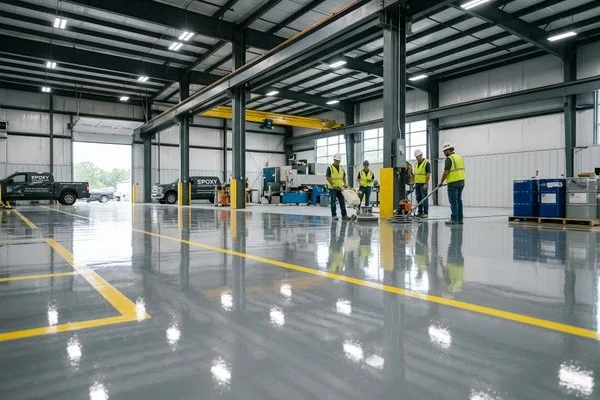
Color Coding and Zone Marking: Define pedestrian lanes, rack footprints, hazard zones, and equipment areas through color-coded floor systems — more durable and permanent than painted lines. This is standard practice in Warren and Sterling Heights manufacturing facilities supplying GM and Stellantis.
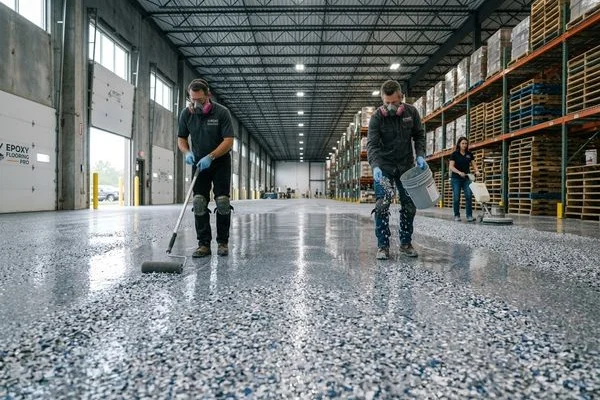
Broadcast Aggregate Systems: Uniform broadcasts of colored quartz or aluminum oxide aggregate create texture for slip resistance and a finished, professional appearance.
Anti-Static and ESD Systems: Conductive carbon or graphite layers beneath the topcoat provide ESD-dissipative performance for electronics assembly, server rooms, and explosive environments — increasingly important as Detroit’s EV manufacturing sector grows at facilities like Factory ZERO.
Custom Color Matching: We can match brand colors, safety colors, or any specified color using custom pigment blending from our coating manufacturer partners.
Long-Term Performance and Maintenance
A properly installed epoxy system requires very little maintenance beyond routine cleaning. To maximize system life in Detroit’s demanding industrial climate:
- Clean promptly after chemical spills — most epoxies have a finite chemical resistance rating based on exposure duration
- Use pH-neutral cleaners for routine maintenance; avoid strong solvents or oxidizing agents
- Address mechanical damage (chips, gouges from dropped loads) promptly with patch repair kits to prevent moisture infiltration — especially critical before winter when freeze-thaw cycling will expand any coating breach
- Plan for a maintenance topcoat at 7–10 years depending on traffic intensity — this is far more economical than full system removal and reinstallation
We provide every client with a written maintenance protocol and can supply touch-up materials for in-house maintenance use.
Project Execution: Working Around Detroit’s Production Demands
We understand that your floor cannot be out of service for weeks — especially in Detroit’s automotive supply chain where a missed delivery window can cascade through the entire production system. Our project management approach is built around your operational calendar:
- Weekend and overnight shifts to minimize production disruption
- Rapid-cure system options for critical path projects — essential for JIT automotive operations
- Phased installation keeping sections of the facility operational
- Pre-mobilization coordination with your facilities and safety teams
- Daily progress reports and photo documentation throughout installation
Contact our Detroit estimating team for a detailed site assessment and system specification tailored to your facility’s specific requirements. We serve the entire metro area from Romulus to Rochester Hills, including Dearborn, Warren, Sterling Heights, and the I-75/I-94 industrial corridors.
What's Included
Our Epoxy & Urethane Installation Process
Site Assessment & Engineering
Our project engineers conduct a full substrate analysis including moisture vapor testing, pH testing, compressive strength evaluation, and existing coating adhesion checks. We document all contamination zones, cracks, and drainage requirements before any specification is finalized.
Surface Preparation
We mobilize shot blasting, diamond grinding, or scarifying equipment sized to your facility. Proper surface preparation to ICRI CSP 3–5 is the single most critical factor in coating longevity — we never skip or shortcut this phase.
Crack & Joint Repair
Structural cracks are routed and filled with semi-rigid polyurea or rigid epoxy depending on movement classification. Control joints are cleaned, filled with appropriate mastic, and ground flush to prevent point loading on the coating.
Primer Application
A penetrating epoxy primer is applied at specified coverage rates to consolidate the substrate and establish chemical adhesion. For moisture-sensitive slabs, moisture-tolerant or moisture-vapor barrier primers are used to prevent delamination.
Base Coat & Build Coat Application
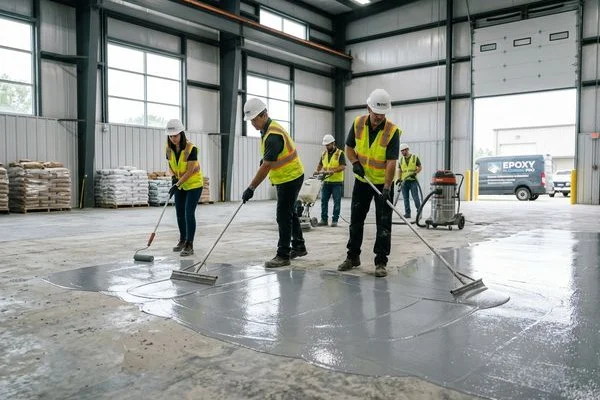
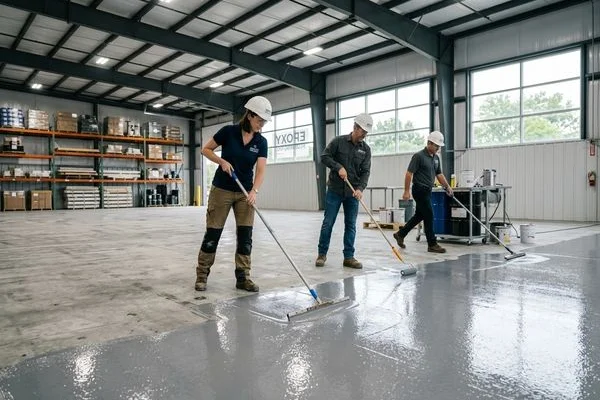
100% solids epoxy base coats are applied by squeegee and back-rolled to achieve uniform film build. Broadcast aggregate or anti-slip media can be incorporated at this stage for texture and slip resistance requirements.
Topcoat & Final Inspection
Urethane or aliphatic epoxy topcoats are applied for UV stability, abrasion resistance, and chemical protection. We conduct holiday testing, adhesion pull tests, and film thickness verification before sign-off and project handover.
Why Choose Epoxy Flooring Pro
Industrial-Only Expertise
We work exclusively in commercial and industrial environments — no residential work, no shortcuts. Every crew member is a career applicator trained on the specific systems we install.
Manufacturer-Certified Applicators
Our teams hold applicator certifications from leading coating manufacturers including Sika, Sherwin-Williams, and Mapei. This matters for product warranty coverage and technical support.
Own All Equipment
We own our shot blasters, grinders, mixing equipment, and application tools. We don't subcontract surface preparation — it stays under our direct quality control from start to finish.
Documented QC Process
Every project receives a written quality control report with substrate readings, product lot numbers, application temperatures, humidity records, and film thickness measurements at defined intervals.
Built for Detroit Production Schedules
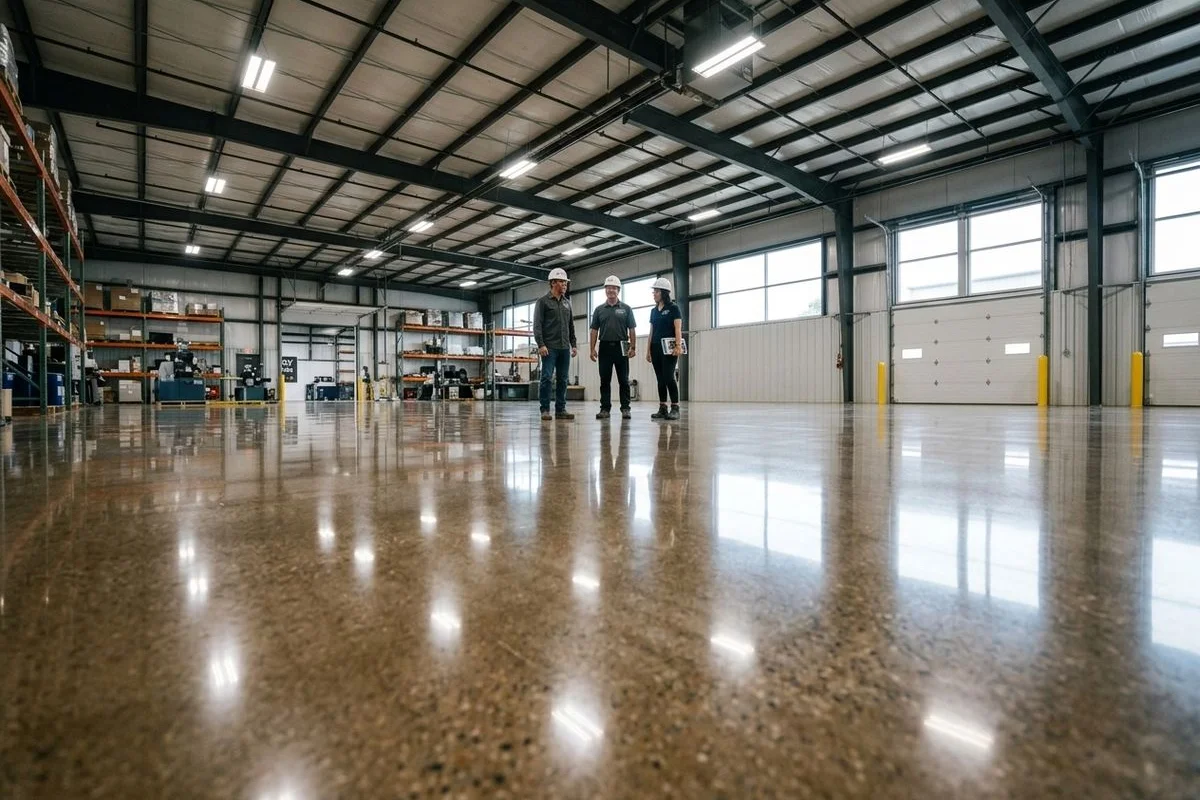
We schedule around your production calendar, work nights and weekends, and can deploy rapid-cure systems that allow foot traffic in as little as 8 hours and forklift traffic in 24 hours — critical for Detroit's just-in-time manufacturing lines.
Project Gallery
Before & After
Before
After
What Our Clients Say
"Our I-94 corridor distribution center runs heavy forklift traffic 22 hours a day. Two previous contractors couldn't get a coating to last more than eight months on our receiving dock. Epoxy Flooring Pro did a full moisture assessment, found the vapor emission issue that was causing delamination, installed the correct barrier primer, and the 100% solids system has been flawless for two years now. They understood the problem before they started mixing material."
"We needed our Dearborn auto supplier plant recoated without interrupting our line feed to the Rouge Complex. Their crew worked three consecutive weekend shifts, prepped and coated 18,000 square feet around our stamping presses, and we were back running Monday morning with zero disruption. The urethane cement system handles our coolant spills and thermal cycling from the wash bay without any issues. This is the team you call for automotive facilities."
"Managing floor coatings across a 400,000 SF manufacturing facility in Warren means dealing with everything from CNC machining coolant to heavy die-cart traffic. Epoxy Flooring Pro specified different systems for different zones — epoxy in the assembly area, urethane cement in the wash bays — and every zone has held up through two Michigan winters. Their engineering approach is what separates them from the guys who just show up and start rolling."
Frequently Asked Questions
How does Detroit's freeze-thaw cycling affect epoxy floor coatings in unheated facilities?
Can you coat automotive manufacturing floors exposed to machining coolants and stamping lubricants?
What is the typical timeline for coating a 20,000 SF Detroit-area manufacturing floor?
Do you work across the entire Detroit metro area including Dearborn, Warren, and Sterling Heights?
How do road salt and deicing chemicals affect floor coatings near loading docks?
Get a Free Estimate for Epoxy & Urethane
Our project managers are ready to assess your facility and recommend the optimal epoxy & urethane solution.